Skip to content




Millions of UK homes suffer from internal damp — and a surprising number of them have the answer written right across their walls. The wrong exterior paint, applied with the best of intentions, can quietly trap moisture inside your brickwork for years.
The Hidden Link Between Exterior Paint and Internal Damp
If you’ve been battling damp patches, peeling plaster, mould, or musty smells inside your home or commercial building, the cause might not be what you think. Many people assume the culprit is a leaking roof, faulty damp-proof course, or rising damp from the ground. But in a significant number of cases — particularly in Victorian, Edwardian, and older brick-built properties — the real problem is painted directly onto the outside walls.
Traditional brick, stone, and lime render are breathable materials. They are designed to absorb and release moisture naturally, allowing buildings to manage humidity the way they were built to. When you coat them with a non-breathable, impermeable paint — such as a standard masonry paint or gloss-based exterior finish — you essentially seal that moisture inside the wall with no way out.
The result? Moisture that enters through rain, condensation, or groundwater has nowhere to go. It migrates inward, eventually showing up as damp on internal walls, ceilings, and plaster — sometimes causing structural damage over time.
Which Exterior Paints Cause the Problem?
Not all exterior paints are equal. The issue arises specifically when non-breathable, film-forming coatings are applied to buildings — especially older ones — that need to breathe.
Paints that commonly cause problems on older buildings:
- Standard Masonry Paint — Many widely available masonry paints create a surface film that blocks vapour movement. Great on modern cavity-wall buildings, but problematic on solid-walled older stock.
- Gloss & Satinwood Exterior Paint — Oil or alkyd-based gloss finishes are completely impermeable. Often used on rendered walls for aesthetics but can trap serious amounts of moisture.
- Textured Tyrolean / Pebbledash Coatings — These thick coatings can hide damp and cracking behind them while making the underlying moisture problem dramatically worse over time.
- Waterproofing Sealants & Silicone Coatings — Applied with good intentions but often misunderstood. Many reduce breathability and trap moisture already present in the substrate.
Better alternatives for older buildings:
- Limewash — Traditional, highly breathable. The right choice for lime-rendered or stone buildings. Allows moisture to move freely through the wall.
- Mineral & Silicate Paints — Bond chemically with mineral substrates and remain vapour-permeable. Excellent for brick and render that needs protection without sealing.
Signs Your External Paint May Be Causing Internal Damp
The following symptoms often point to moisture being trapped by external paint:
- Damp patches on internal walls — particularly on external-facing walls, often appearing in winter when temperature differentials increase condensation.
- Efflorescence on brickwork — the white salt deposits forming on exterior walls are a classic sign of moisture moving through the wall and being stopped by a surface coating.
- Paint blistering and bubbling externally — trapped moisture forces its way through the paint film, creating bubbles and eventually causing the paint to flake off.
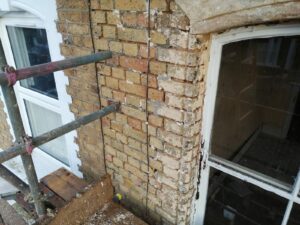
- Spalling brickwork — in cold weather, trapped moisture freezes and expands inside the brick, causing the face of bricks to break away. This is a serious structural issue that escalates over time.
- Persistent musty smells inside — even without visible patches, trapped moisture in walls contributes to elevated humidity and mould growth inside rooms.
Important: Before spending money on internal damp treatments, tanking, or re-plastering, it’s worth having a professional assess whether your external paint is the underlying cause. Treating symptoms internally while the external source remains will simply result in the damp returning.
How Professional Paint Removal Works
Removing paint from the exterior of a building is a specialist job. The method used depends heavily on the substrate beneath — brick, stone, render, concrete — and the type and thickness of the paint applied. LBC uses the following proven methods:
DOFF Steam Cleaning
Our most popular method for sensitive substrates. The DOFF system delivers superheated steam at very high temperatures (up to 150°C) but at low pressure, which effectively softens and lifts paint without damaging the surface beneath. It’s ideal for brick, stone, terracotta, and listed buildings where abrasive methods would cause damage. DOFF also kills biological growth like algae and moss in the same pass.
Pressure Washing
For harder substrates and heavier paint buildups, controlled high-pressure washing can be highly effective. Our technicians calibrate pressure carefully to match the material — too high and you can erode mortar joints or damage brick faces, which is why this work must be done professionally rather than with a domestic pressure washer.
Chemical Paint Strippers
For particularly stubborn or multi-layered paint coatings, biodegradable chemical paint strippers are applied to the surface, left to dwell, and then cleaned off — typically with hot water washing. These are non-damaging to masonry and very effective on thick or glossy coatings.
Combination Approaches
Many jobs benefit from a combination of methods — for example, a chemical pre-treatment followed by DOFF steam cleaning. Our team assesses each building individually and recommends the safest, most effective approach.
What Happens After the Paint Is Removed?
Once the non-breathable coating is removed, the building can begin to dry out naturally. Depending on how long the moisture has been trapped, this can take anywhere from a few weeks to several months. In most cases, internal damp problems begin to resolve on their own as the walls dry from the inside out.
After removal, we can advise on appropriate breathable protective treatments if required — limewash, mineral paint, or breathable masonry coatings — to protect the building without resealing it. If re-coating isn’t needed, leaving clean brick or stone exposed is often the best outcome for the long-term health of the building.
Frequently Asked Questions
Can you remove paint from brick without damaging it?
Yes — when the right method is used. DOFF superheated steam cleaning is specifically designed for delicate masonry and is commonly used on listed buildings and heritage structures. The key is professional assessment of the substrate before any work begins. Domestic pressure washers or aggressive abrasive methods can cause irreversible damage, which is why specialist contractors like LBC are the only safe option.
Will removing the exterior paint fix my internal damp?
In many cases, yes — particularly in solid-walled or older properties where a non-breathable coating is the primary cause. Once the external coating is removed, moisture trapped in the walls can evaporate outward, and internal damp patches typically improve significantly within weeks to months. However, if there are other contributing factors such as a failing damp-proof course, roof leaks, or poor drainage, these will need to be addressed separately.
How do I know what type of paint is on my building?
Our team can assess this during a site survey. Visually, film-forming non-breathable paints often show signs of blistering, flaking, or a shiny surface appearance. Efflorescence — white salt deposits pushing through the paint — is a strong indicator of trapped moisture. We can also carry out simple tests on-site to check breathability levels.
How much does exterior paint removal cost in London?
Cost varies based on the size of the building, the paint type, substrate material, and method required. Residential properties typically range from a few hundred to a few thousand pounds depending on scale. Commercial buildings vary more widely. LBC provides free, no-obligation quotes — contact us with photos and approximate dimensions for a fast estimate.
Can you remove paint from rendered walls?
Yes, though render requires particular care. The condition of the render underneath the paint needs to be assessed first — if the render itself is compromised, removal may disturb it. Where the render is sound, DOFF steam cleaning and chemical strippers are both effective. We can advise whether the existing render should be retained after stripping or whether re-rendering is a better long-term solution.
Do I need planning permission to remove paint from my building’s exterior?
In most cases, no. However, if your property is listed or sits within a Conservation Area, you may need to notify or seek consent from your local planning authority before undertaking exterior works. LBC works regularly in Conservation Areas and with listed buildings across London and can advise accordingly.
How long does exterior paint removal take?
For a typical Victorian or Edwardian terraced or semi-detached home, the main work usually takes one to two days. Larger commercial buildings or those with particularly stubborn multi-coat paint systems may take longer. We work efficiently and where needed can stage work to minimise disruption.
Is the paint removal process noisy or disruptive?
DOFF steam cleaning is relatively quiet compared to mechanical methods, though there is some noise from equipment. The process is also clean — DOFF uses very little water compared to pressure washing — and we manage all runoff and waste responsibly. Residents can typically remain in the property throughout the work.
What areas of London does LBC cover for paint removal?
LBC covers all of Greater London and surrounding areas. We work with residential homeowners, housing associations, property management companies, and commercial clients across North, South, East, and West London, as well as home counties locations. Contact us to confirm coverage for your specific area.
After removing the paint, what should I put on the walls to protect them?
For older brick-built or stone buildings, we generally recommend leaving the surface bare or using a breathable treatment such as limewash or a mineral silicate paint. Avoid applying new non-breathable coatings — this would recreate the original problem. For modern cavity-wall buildings, there are more options available. Our team will advise based on your specific building type and substrate after inspection.
Get a Free Quote for Exterior Paint Removal
Call: 020 8088 0611 | WhatsApp: 07910 044833